

Written by Arnaldo León, Licensed Viatical Settlement Broker | Planwise Partners
What If Your Life Insurance Policy Is Worth More Than You Think?
Life settlements can provide policy owners with an additional option when an existing life insurance policy is no longer needed, has become difficult to afford, or no longer serves its original purpose. If you are considering selling a life insurance policy, it is important to understand all of your options before making an irreversible decision. Most people believe there are only two choices, when they no longer want or can no longer afford—a life insurance policy: keep paying for it or cancel it. But there may be a third option.
Your life insurance policy is a financial asset, and under certain circumstances, you may be able to sell it to a third party through a transaction known as a life settlement.
Instead of allowing the policy to lapse for nothing or surrendering it to the insurance company for its available cash surrender value, a qualified policy owner may be able to sell the policy in the secondary market and receive a lump-sum payment.
Typically, that settlement is more than the policy’s cash surrender value but less than its death benefit. The exact value depends on the insured’s age and health, the policy’s economics, future premiums, death benefit, policy type, and market conditions.
According to recent industry market data, consumers completing life-settlement transactions have frequently received substantially more than the cash surrender value available from their insurance companies. That does not mean every policy will receive the same result, but it illustrates why exploring the secondary market before surrendering a policy can matter.
The important question may not simply be:
“Do I still want this policy?”
It may be:
“What are all of my options before I give this policy back?”
How Do Life Settlements Work?
A life settlement occurs when the owner of an existing life insurance policy sells the policy to a third party.
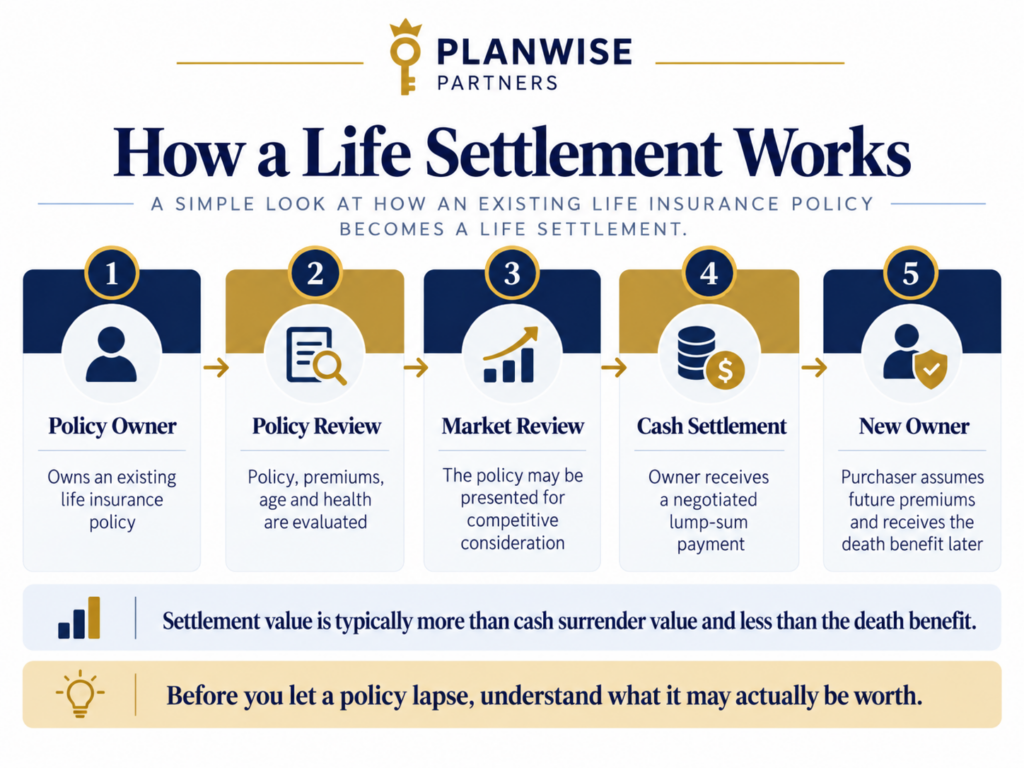
In exchange:
- The policy owner receives an agreed-upon cash payment
- Ownership and beneficiary rights are transferred
- The new owner becomes responsible for future premiums
- When the insured eventually passes away, the new owner receives the applicable death benefit
The original policy owner receives liquidity today instead of leaving the policy’s future death benefit to the existing beneficiaries. That trade-off is exactly why a life settlement should be evaluated carefully, not treated simply as a way to get cash.
Who May Qualify for Life Settlements?
You may often hear that life settlements are for people 65 or older with policies of at least $100,000. Those are useful marketplace guidelines, but they are not universal eligibility rules.
Purchasers establish their own underwriting criteria. Age, health, life expectancy, policy size, future premium requirements, and policy structure all affect whether a policy is marketable.
Most life-settlement buyers tend to focus on insureds approximately age 65 or older, although a younger individual with a significant change in health may also qualify. Policies with death benefits of $100,000 or more are commonly considered, but some buyers evaluate smaller policies as well.
Could Your Policy Qualify?
Age, health, policy type, death benefit and future premium requirements can all influence eligibility.
A review doesn’t mean you have to sell. It simply helps you understand your options.
See If My Policy QualifiesWhat Determines the Value of Your Policy?
Life settlements are individually underwritten. Several factors affect what a buyer may be willing to pay.

Important: Cash surrender value alone does not determine what a policy may be worth in the secondary market.
Your Age and Health
Life expectancy is one of the most significant factors in the valuation process. Changes in health since the policy was originally issued can materially affect the policy’s secondary-market value.
Interestingly, a decline in health can make a policy more valuable in the life-settlement market, because the buyer is estimating how long it may need to continue funding premiums before receiving the death benefit.
The Death Benefit
Larger policies may attract more institutional buyers, although smaller policies can sometimes qualify.
Future Premium Requirements
Two policies with identical death benefits can have very different market values if one requires substantially higher future premiums to remain in force.
Policy Type and Structure
Guarantees, cash value, cost of insurance, maturity provisions, conversion rights, and other contractual terms can influence value.
Current Market Conditions
A life settlement is ultimately a market transaction. Different buyers may value the same policy differently.
That last point becomes extremely important when deciding how to sell the policy.
What Types of Life Insurance Policies Can Be Sold?
One misconception is that only Universal Life policies qualify.
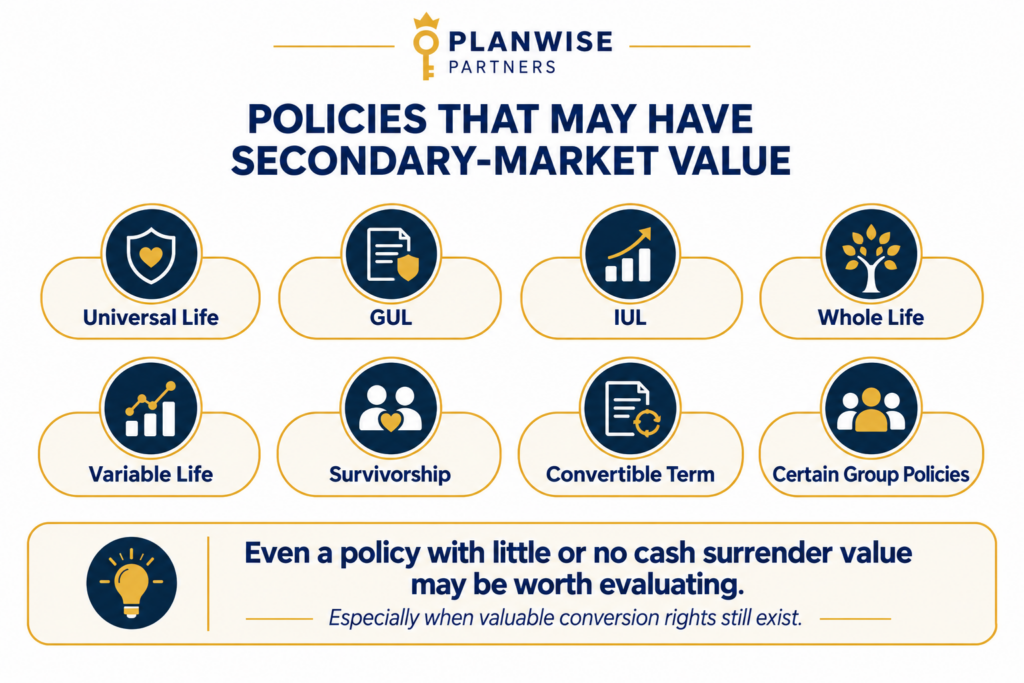
Although Universal Life policies represent a significant portion of the life-settlement market, multiple types of life insurance may potentially qualify, including:
- Universal Life
- Guaranteed Universal Life
- Indexed Universal Life
- Whole Life
- Variable Life
- Survivorship policies
- Term Life with valuable conversion rights
- Certain group policies
Even some policies with little or no cash surrender value can potentially have secondary-market value.
For example, a convertible term policy approaching the end of its term may appear to have no value if the owner simply allows it to expire. But depending on its conversion rights, the insured’s health, age, and economics of the resulting permanent coverage, it may be worth evaluating before expiration.
Variable life policies require additional attention because variable life insurance is also a security. Life settlements involving variable policies can therefore trigger federal securities regulations in addition to state insurance regulation.
When Might Life Settlements Be Worth Considering?
There is no single “perfect” life-settlement client. Instead, look for changes in circumstances.
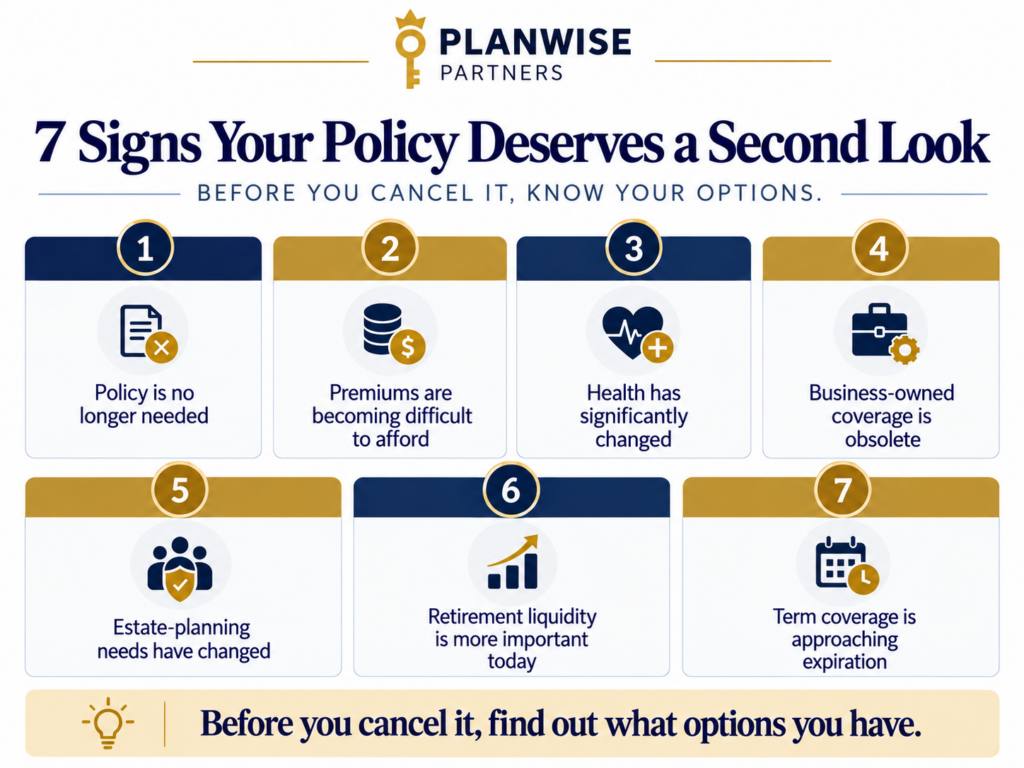
1. The Policy Is No Longer Needed
Perhaps the policy was originally purchased for income replacement while children were young. Twenty-five years later:
- The children are financially independent
- The mortgage is paid
- Retirement assets are sufficient
- The surviving spouse no longer needs the full death benefit
The policy may have accomplished what it was designed to accomplish. That doesn’t necessarily mean the owner should surrender it immediately. It means the policy deserves a review.
2. Premiums Have Become Difficult to Afford
A policy that made sense while someone was working may become increasingly difficult to maintain during retirement. The owner may now be choosing between:
Maintaining a death benefit for the future or Preserving retirement cash flow today.
Before simply allowing the policy to lapse, a life-settlement evaluation may reveal another option.
3. The Insured’s Health Has Changed
This can be counterintuitive. Normally, deteriorating health is bad news in life insurance underwriting. In the life-settlement market, however, a shorter life expectancy can increase the economic value of an existing policy. Someone who purchased coverage while healthy but has since experienced a significant change in health may own an asset worth substantially more in the secondary market than its cash surrender value.
4. A Business-Owned Policy Is No Longer Needed
Consider a business owner who purchased life insurance to fund:
- A buy-sell agreement
- Key-person protection
- Business succession planning
- Loan protection
Years later, the business is sold, the partner retires, the loan is paid, or the succession strategy changes.
What happens to the insurance?
Instead of immediately surrendering or terminating it, the business or policy owner should consider whether the policy itself has market value.
5. Estate-Planning Needs Have Changed
Life insurance is frequently purchased to provide estate liquidity or create an inheritance. But family circumstances and estate-planning laws change.
An individual may discover that the amount of coverage originally purchased is no longer necessary. Instead of surrendering excess coverage, a life settlement may provide an opportunity to convert part of that legacy asset into usable capital today.
6. Retirement Needs Have Changed
Some retirees eventually determine that liquidity today is more important than the original death benefit.
Life-settlement proceeds might be repositioned toward:
- Retirement needs
- Long-term care expenses
- Medical expenses
- Debt reduction
- Family needs
- Other investments or financial strategies
Depending on the individual’s goals, it may also be helpful to understand how a Life Insurance Retirement Plan (LIRP) can be used for long-term accumulation and supplemental retirement income before making changes to existing life insurance coverage.
The important consideration is not simply what can be done with the proceeds, but what the client is giving up in exchange.
7. A Term Policy Is Approaching Expiration
This is one of the easiest situations to overlook. Someone may have paid premiums for 20 or 30 years and assume:
“My term is ending, so I guess the policy is worthless.” Not necessarily. If conversion privileges remain, the policy may warrant review before the conversion window closes.
The worst time to investigate your options is after an important contractual right has already expired.
Lapse vs. Surrender vs. Life Settlement
This is where understanding your options becomes particularly important.
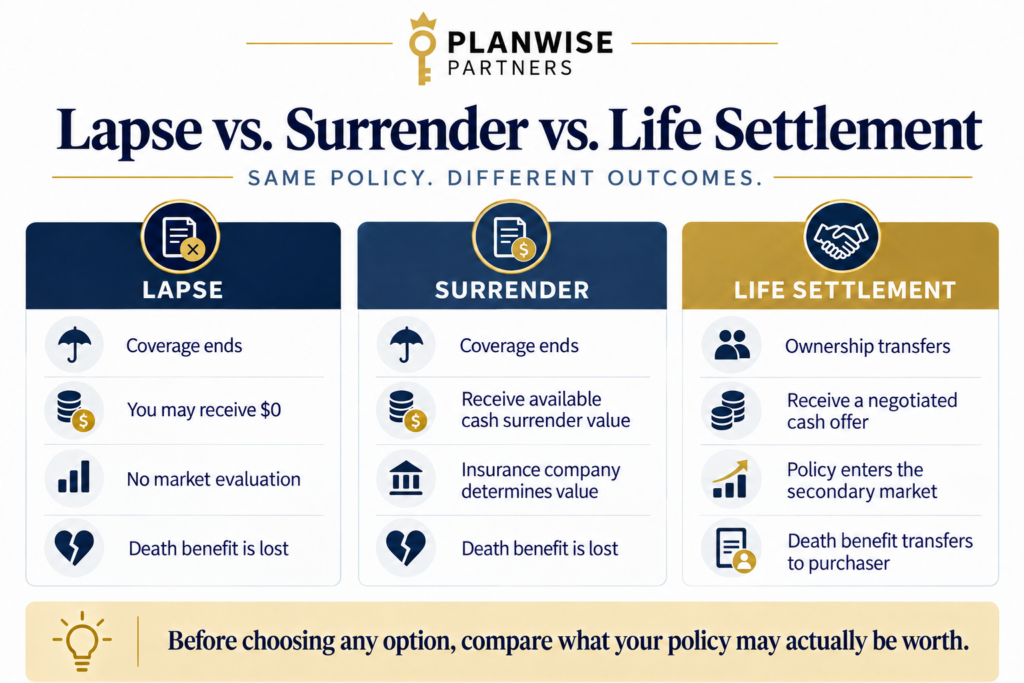
Let the Policy Lapse
If the policy lapses without value: You may receive nothing.
Coverage terminates, and the years of premiums previously paid do not create a settlement payment simply because the policy once existed.
Surrender the Policy
With a permanent policy containing cash value, the insurance company may provide the applicable cash surrender value, after loans, surrender charges, or other applicable adjustments.
That may be appropriate. But it tells you what the insurance company will provide; not necessarily what someone in the secondary market might be willing to pay for the policy.
Sell the Policy Through a Life Settlement
A qualified policy could potentially receive an offer greater than its cash surrender value.
This doesn’t automatically make selling the correct decision. It means the owner now has another number to compare:
Keeping the policy.
Modifying the policy.
Surrendering the policy.
Or selling the policy.
An informed decision should evaluate all four.
Broker vs. Provider: One of the Most Important Decisions You’ll Make
If you’ve decided to explore a life settlement, there are two primary ways the transaction may reach the market:
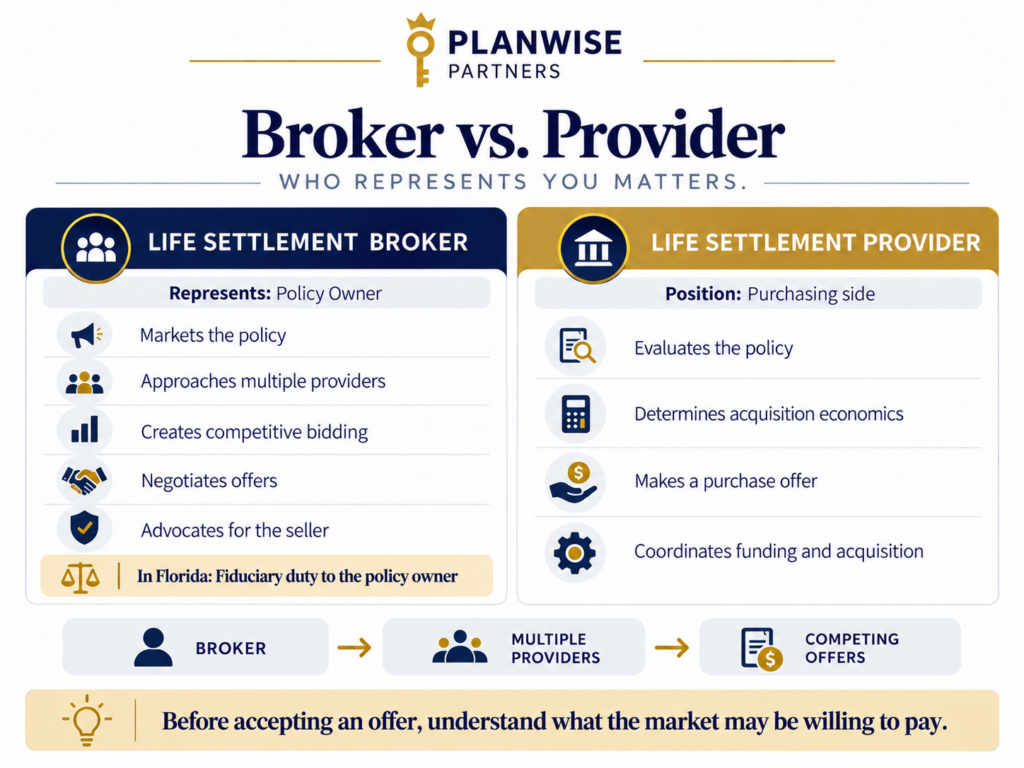
Work through a life-settlement broker or Work directly with a life-settlement provider.
Understanding the difference matters.
What Does a Life-Settlement Broker Do?
A broker works on behalf of the policy owner—the seller.
The broker’s role is typically to:
- Evaluate the policy
- Package the case for the market
- Approach multiple licensed providers
- Solicit competing offers
- Negotiate terms
- Help the seller compare bids
- Advocate for the policy owner’s interests
In Florida, this isn’t merely a marketing description. State law provides that a viatical settlement broker represents only the policy owner, legally referred to as the viator, and owes the owner a fiduciary duty to follow the owner’s instructions and act in the owner’s best interest. Florida also requires disclosure regarding broker compensation.
| Thinking About Selling a Policy? Don’t Start With an Offer. Start With a Review. |
| As a licensed Viatical Settlement Broker, Arnaldo León works from the policy owner’s side of the transaction, helping clients understand their options and, when appropriate, bringing their policy to the marketplace for competitive consideration. Before accepting an offer, understand what the market may be willing to pay. |
Think about selling real estate. If you list your property with someone representing you, part of that person’s job is to expose the property to the market and negotiate.
A life-settlement broker performs a similar market-making role for the policy.
What Does a Life-Settlement Provider Do?
A provider operates on the purchasing side of the transaction.
Providers may purchase policies using institutional capital, hold policies, finance transactions, or ultimately transfer policies to other investment entities.
Importantly, a provider dealing directly with a policy owner does not occupy the same seller-side fiduciary role as a broker.
That doesn’t make providers bad. Providers are essential participants in the life-settlement marketplace. But economically, the two parties are negotiating opposite sides of the same transaction:
The seller wants appropriate market value.
The purchaser wants an acquisition that makes economic sense.
That distinction matters.
Why Competition Matters
Suppose someone offers you $175,000 for your house.
Is that a good offer? Maybe. But without knowing whether someone else would pay $200,000, $225,000, or $250,000, you don’t really know.
Life settlements can work similarly.
Shopping the policy among multiple potential purchasers can help establish what the marketplace may actually be willing to pay.
Working through a broker can create competition among potential purchasers. A broker will generally receive compensation for that work, so the appropriate question isn’t simply:
“Does the broker charge a fee?”
It is:
“What is my net outcome after compensation, and did competitive bidding improve the value I received?”
The question isn’t simply, “What will someone offer me?” The better question is, “What might the marketplace be willing to pay?”
What About Those Life-Settlement Commercials?
Consumers may encounter television, radio, digital, or direct-response advertisements encouraging them to sell their policies. Some advertisements come directly from providers. Others may come from brokers or marketing and lead-generation companies.
Don’t assume. Ask:
Are you a broker representing me, a provider seeking to purchase the policy, or a marketing company referring my information somewhere else?
That one question can tell you a great deal about the relationship you’re entering.
Don’t Sell Before Reviewing the Alternatives
A life settlement can be valuable, but selling should not automatically be the first option.
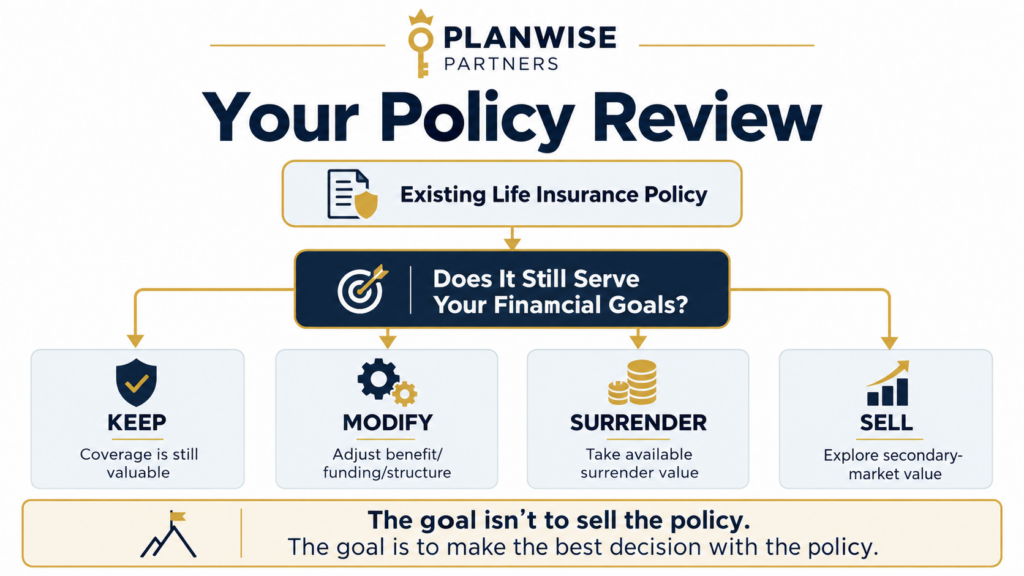
Depending on the policy and the owner’s objectives, alternatives might include:
- Keeping the existing policy
- Reducing the death benefit
- Changing premium funding
- Using available cash value
- Taking a policy loan
- Electing reduced paid-up insurance when available
- Using extended-term options when available
- Exploring an accelerated death benefit
- Completing an appropriate Section 1035 exchange
- Converting term insurance before conversion rights expire
- Adjusting beneficiaries or ownership as part of updated estate planning
Because every policy and financial objective is different, reviewing your broader life insurance options before making an irreversible decision can help put the policy in context with the rest of your financial strategy.
Sometimes selling is the right answer. Sometimes keeping the policy is considerably more valuable. The purpose of a review is to determine which.
Important Risks and Considerations
A life settlement should never be presented as “free money.” There are real trade-offs.
Your Beneficiaries Lose Some or All of the Death Benefit
Once the policy is sold, the purchaser generally becomes the beneficiary. That means your family typically will not receive the benefit they would have received had you retained the policy.
The Transaction May Create Tax Consequences
Life-settlement proceeds are not automatically tax-free. Federal tax treatment depends on several factors, including the policy owner’s investment in the contract, cash surrender value, settlement proceeds, and the specific circumstances of the transaction.
Depending on the situation, a sale can potentially result in different portions being treated differently for tax purposes. Always involve a qualified tax professional before completing the transaction.
Government Benefits May Be Affected
Receiving a substantial lump sum could affect eligibility for certain means-tested government programs such as Medicaid.
This should be evaluated before accepting a settlement.
Creditors May Potentially Have Access to the Proceeds
Settlement proceeds may also receive different creditor protection than the life insurance policy itself. The owner’s legal and financial circumstances should therefore be considered before completing a transaction.
Your Medical Information Will Be Reviewed
Life expectancy is central to valuation. That means medical records and other sensitive information will typically be requested and reviewed as part of underwriting. Policy owners should understand who will have access to their information and how it will be protected.
Future Insurability Should Be Considered
Even after the policy is sold, it remains insurance on your life. That existing death benefit can potentially affect your ability to obtain additional coverage, and replacing the protection later may be difficult or expensive, particularly if your health has changed.
This should be reviewed before, not after, completing the sale.
Life Settlements Are Regulated, and Rules Vary by State
Life settlements are primarily regulated at the state level, which means requirements can differ depending on where the policy owner resides.
For example, Florida regulates these transactions under its viatical-settlement laws and requires licensing, consumer disclosures, privacy protections, anti-fraud procedures, and other safeguards. Florida also generally restricts life-settlement transactions involving policies during the first two years after issuance, subject to statutory exceptions.
Another important Florida consumer protection is a 15-day rescission period after receiving settlement proceeds, subject to applicable statutory requirements.
Because regulations vary by jurisdiction, always work with appropriately licensed professionals in the state governing the transaction.
Before You Cancel Your Policy, Have It Reviewed
A life insurance policy may have spent decades protecting your family, your business, or your estate. If circumstances have changed, the solution doesn’t necessarily have to be: “Cancel it.”
There may be value hidden inside the contract that isn’t reflected by its cash surrender value. Before letting a policy lapse or surrendering it back to the insurance company, consider asking:
Do I still need the coverage?
What alternatives does the insurance company offer?
What is the current cash surrender value?
Could the policy qualify for a life settlement?
What might multiple buyers be willing to pay for it?
What will my beneficiaries give up if I sell it?
What will I actually receive after fees, commissions, and taxes?
Those questions turn a cancellation decision into a financial-planning decision.
The Bottom Line
Life settlements aren’t appropriate for everyone.
For some policy owners, keeping the policy and preserving the death benefit may be overwhelmingly more valuable than selling it.
For others, particularly individuals with changing insurance needs, rising premium obligations, changed health conditions, obsolete business coverage, or a greater need for liquidity; the secondary market may provide an option they didn’t know existed.
The mistake isn’t choosing to keep your policy. And the mistake isn’t choosing to sell it.
The mistake is allowing a potentially valuable financial asset to disappear without first understanding what your options are.
Before You Lapse or Surrender, Request a Policy Review
At Planwise Partners Insurance Agency, we believe education should come before a financial decision.
As a licensed Viatical Settlement Broker, Arnaldo León can help you review your existing policy, understand the alternatives available to you, and determine whether keeping, modifying, surrendering, or exploring the life-settlement marketplace deserves further consideration. If a life settlement is appropriate, we can help guide you through the process and seek competitive opportunities for your policy rather than allowing you to make a decision without first understanding its potential market value.
Before you walk away from your policy, find out what it may actually be worth.
Request a Confidential Policy ReviewImportant Disclosure
This article is provided for general educational and informational purposes only and should not be considered individualized insurance, investment, tax, accounting, or legal advice. Life-settlement eligibility, offers, regulations, licensing requirements, and tax consequences vary by policy, individual circumstances, and jurisdiction.Planwise Partners Insurance Agency and Arnaldo León are not CPAs, Enrolled Agents, attorneys, or licensed tax professionals. For tax or legal advice specific to your situation, please consult an appropriately qualified professional. Planwise Partners collaborates with trusted tax and legal professionals and can provide an introduction upon request.
Sources & Additional Resources
The following independent resources are provided for readers who would like to learn more about life settlements, applicable regulations, consumer considerations, and federal tax-reporting requirements.
Florida Legislature — Florida Statutes, Chapter 626, Part X: Viatical Settlements
Florida’s statutory framework governing viatical and life-settlement transactions, including licensing requirements, broker and provider responsibilities, required disclosures, consumer protections, and transaction procedures. View the 2026 Florida Viatical Settlement Statutes
FINRA — What You Should Know About Life Settlements
Consumer guidance addressing how life settlements work, factors to consider before selling a policy, shopping for competitive offers, broker compensation, privacy, taxation, and the potential impact on beneficiaries and future insurance needs. FINRA specifically advises consumers to understand whether the person they are working with represents them or is affiliated with a particular settlement company. Read FINRA’s Life Settlement Consumer Guidance
Internal Revenue Service — Instructions for Form 1099-LS, Reportable Life Insurance Sale
Official IRS guidance concerning federal information-reporting requirements associated with certain reportable sales of life insurance contracts. Review IRS Form 1099-LS Guidance
Life Insurance Settlement Association — 2025 Annual Market Data
Industry data regarding life-settlement transactions completed by participating LISA members, including settlement proceeds, cash surrender values, policy face amounts, and other marketplace statistics. Review LISA’s 2025 Life Settlement Market Data
Important Note
These resources are provided for educational and informational purposes only. References to governmental agencies, regulatory organizations, statutes, or industry associations do not imply endorsement of Planwise Partners Insurance Agency, Arnaldo León, or any services offered. Life-settlement laws, eligibility requirements, tax consequences, and transaction procedures may vary by jurisdiction and individual circumstances. Readers should consult appropriately licensed insurance, tax, and legal professionals regarding their specific situation.
Sources reviewed: September 2026.